- Home Page
- Advice and Planning
- How Difficult is the Norfolk Coast Path?
How Difficult is the Norfolk Coast Path?
The Norfolk Coast Path isn't a particularly difficult long-distance trail in terms of hills or climbing. Norfolk is famously flat, and you certainly won't be spending your days tackling steep mountain paths.
But I wouldn't describe the whole walk as easy either.
The Norfolk Coast Path is relatively flat compared with many of Britain's long-distance trails, but that doesn't necessarily make every mile easy. There are stretches of shingle (4 miles to be precise) and soft sand that can slow you down, and much of the coastline is obviously exposed to the wind. These are the things I'd bear in mind when deciding how far to walk each day.
If you're reasonably fit, used to regular walking and you choose daily distances that suit you, it's a very achievable long-distance walking holiday.
How difficult is it at a glance?
| Hills | Generally easy – there are a couple of inclines either side of Sheringham, and to be honest, I would say that was it. There is no significant climbing. |
|---|---|
| Paths | Mostly straightforward. |
| Navigation | Very easy to follow. |
| Underfoot | Varied – paths, tracks, sand, beach and shingle. |
| Daily distances | Depends very much on the itinerary you choose. |
| Weather | Exposure to wind, rain and sun can make a noticeable difference. |
| Overall | A very manageable long-distance trail for regular walkers, but don't assume that flat means effortless. |
Does Norfolk's flat terrain make the Coast Path easier?
One of the attractions of walking in Norfolk is that you aren't continually climbing and descending.
For many people, that makes the Norfolk Coast Path much more approachable than some other trails such as the South West Coast Path, or Coast to Coast.
There are some undulations, particularly around the Cromer and Sheringham area, but we're not talking about mountain walking.
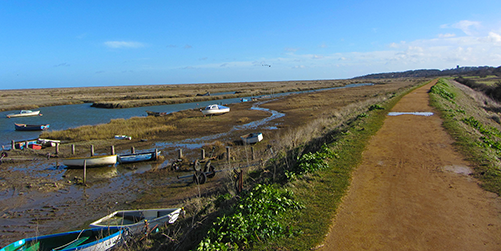
The thing I would be more interested in when deciding whether the Coast Path is right for you is how comfortable you are walking the daily distances.
Walking ten miles over relatively flat ground is still walking ten miles.
And on a walking holiday, you'll be getting up and doing it again the following morning.
How Far Should I Walk Each Day on a Walking Holiday?
What is the terrain like on the Norfolk Coast Path?
This is probably the part of the Norfolk Coast Path that people can underestimate.
Not every mile is on a lovely firm footpath.
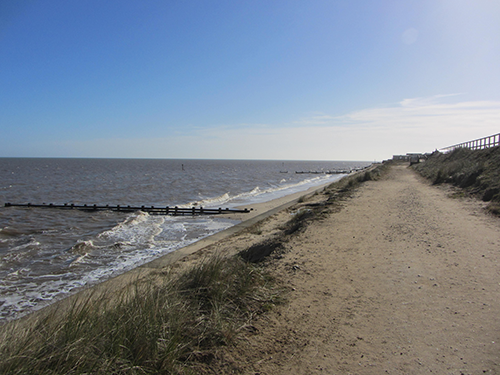
You'll walk on paths, tracks and promenades, but you'll also come across sand on the beaches and shingle around Cley and Weybourne.
Walking on shingle
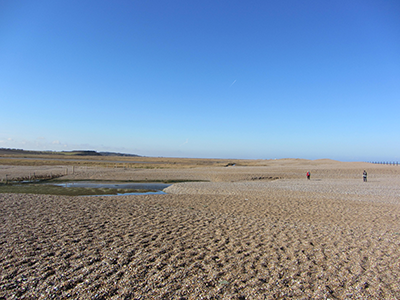
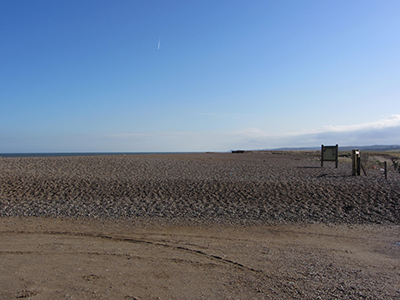
The shingle section around Cley is one of the stretches I would particularly mention to walkers. If you book through Norfolk Walking Holidays, you’ll receive an alternative to this particularly tricky stretch.
Walking on loose stones takes more effort than walking the same distance on a firm path. Your feet move slightly with every step and progress can feel slower. It can feel a bit like one step forward and two steps backwards sometimes.
However, it's perfectly walkable, but if you haven't walked any distance over shingle before, you may be surprised by how much more tiring it feels.
It's one reason I don't think it's useful to judge a Coast Path itinerary purely by looking at the mileage.
Eight miles of mixed coastal terrain isn't necessarily going to feel the same as an eight-mile country walk on good paths.
What about walking on sand?
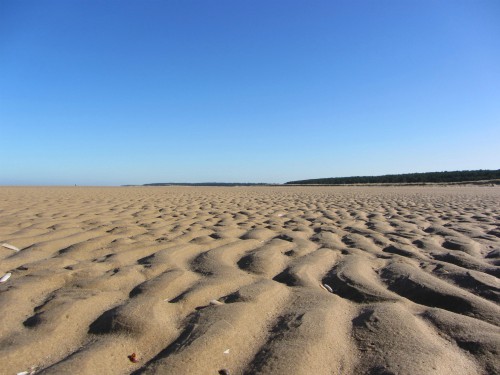
There are also places where you'll be walking on or close to beaches.
Firm sand can be lovely to walk on. Soft sand is another matter entirely. However, more often than not you’ll be able to divert onto slightly harder terrain within the sand dunes.
Conditions can also vary, which is part of the nature of a coastal trail.
None of this makes the Norfolk Coast Path technically difficult. You don't need scrambling skills or specialist mountain-walking experience! Poles can sometimes be useful though.
You just need to allow for the fact that the surface under your feet changes.
The wind can be harder than the hills
There may not be many hills, but there is plenty of sky and it's what Norfolk is best known for.
Much of the Norfolk coast is open and exposed, and on a windy day you'll know about it.
A strong headwind can make an otherwise straightforward day's walking much more tiring. Equally, on a calm day with the wind behind you, you can cover the same ground and wonder what all the fuss was about!
That's one of the things I enjoy about walking on the coast. The same stretch of path can feel quite different on two different days.
But it does mean that it's worth keeping something in reserve rather than planning every day at the absolute limit of the distance you're capable of walking.
Is the Norfolk Coast Path suitable for a first
long-distance walk?
Yes, I think it definitely can be.
In fact, there are several reasons why Norfolk works well for someone trying a multi-day walking holiday for the first time.
There aren't any significant climbs, the route passes through plenty of villages and towns, and you can choose an itinerary with daily distances that suit you.
But I'd still recommend doing some regular walking beforehand.
The important preparation isn't necessarily proving that you can walk one very long day. It's getting your body accustomed to walking reasonable distances regularly.
Your First Long-Distance Walking Holiday: What to Expect
Walking several days in a row
This is something that's easy to overlook when looking at an itinerary.
Perhaps you regularly walk ten miles at the weekend and know you can comfortably manage it. That's a good start.
But on a walking holiday, after those ten miles you have dinner, sleep, and then put your walking shoes back on the next morning.
By day three or four, tired legs or a small blister can make themselves known. That's why choosing the right itinerary matters.
For the section between Hunstanton and Cromer, for example, you can spread the walk over four, five or six walking days.
The four-day option has longer days. The six-day option brings most of the mileage down considerably.
Neither is better. They simply suit different walkers.
How Many Days Do You Need to Walk the Norfolk Coast Path?
Do I need to be very fit?
You don't need to be an athlete.
If you're already comfortable going out for regular walks of several miles and can build up your distance before the holiday, the Coast Path should be well within reach for most reasonably fit walkers.
I'd be more cautious if your holiday was going to be the first substantial walking you'd done for months. A little preparation beforehand makes the actual holiday much more enjoyable.
And if you're unsure between two itineraries, I'd generally rather see someone give themselves a little more time than choose longer days simply because they think they ought to.
So, is the Norfolk Coast Path hard?
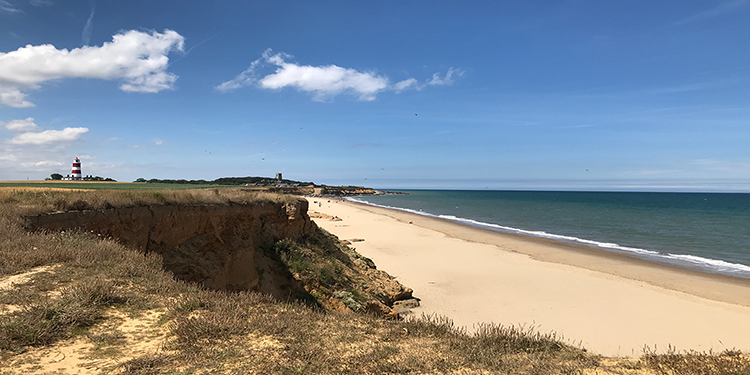
I'd describe it as easy to moderate rather than difficult.
There are no mountains and very little serious climbing. Navigation is generally straightforward and you certainly don't need specialist hiking skills.
The challenges are more subtle, as I’ve mentioned: shingle, sand, coastal weather, daily mileage and the cumulative effect of walking day after day.
Choose an itinerary that suits the way you normally walk, prepare with some regular walks beforehand and don't underestimate the effect of the terrain, and the Norfolk Coast Path will make for a very rewarding first - or fifteenth - long-distance walking holiday.
You can compare the different daily distances in How Many Days Do You Need to Walk the Norfolk Coast Path?
Or see our Norfolk Coast Path walking holidays to compare the different itineraries.
CONTACT DETAILS:
Suzy Watson
+44 (0)7765 668188
walks@norfolkwalkingholidays.com
Feel free to contact me and we can discuss further



Keep up to date with our latest Norfolk Walking Holiday news
Copyright © norfolkwalkingholidays.com; 2014 –